Revival Meetings: ANYTHING GOES, HAIR, and FOLLIES

 Theater Reviews Page | Previous Theater Review | Next Theater Review

Revival Meetings: Anything Goes, Hair, and Follies

A slightly shorter version of this piece appeared in the Winter 2012 issue of The Hopkins Review (New Series 5.1)

           Viewed as something of a genre unto itself, the Broadway stage, more than most art forms, persists through recycling, especially these days.  On a recent August weekend, I set out to sample the purest form of this recycling with what is arguably the purest product of the American stage: revivals of great American musicals, in this instance from three decades: Anything Goes, from the 1930s, Hair, from the 1960s, and Follies, from the 1970s.

The Recycling Bin

            On that recent August weekend, there were 24 shows on Broadway, and of those, only three were neither revivals nor jukebox musicals based on existing pop songbooks nor adaptations from other genres.  This represents a huge change from the way things used to be.  Although August once was much more fallow than it is today on Broadway, it bears note in that same August weekend in 1934, the year of Anything Goes, six of the seven Broadway shows playing were original productions.  In the same weekend in 1968, the year Hair came to Broadway, 8 of 16 shows were original.  And in August 1971, the year of Follies, 9 of 16 were original.  Based on these four datapoints, it would seem that the tide of derivativeness has been generally rising for at least the last 80 years.

            If Broadway is the pinnacle of American theater, and is a limited resource (40 stages), we are demonstrably devoting the bulk of our efforts at that pinnacle to works that started life in other genres and/or bygone times, and that we are largely crowding out new ones conceived (as my three exemplars once were) directly for the stage.

Issues for Revivals

            I come to anatomize this trend, not to praise it or dispraise it.  And in particular I come to consider issues unique to the quintessential form of recycling, viz. revivals.  They do, after all, pose a unique set of challenges to those who stage them, and a unique set of questions to be considered by a contemporary audience.  How does a show from one era fare in front of the audiences from a later one?  One has to assume that the work is viewed as having something to offer, or it would not be re-presented.  Yet audience sensibilities inevitably will have changed.  Does the contemporary production team tailor the work to those sensibilities, or does it count on the audience to make allowances and enjoy the work as more or less originally presented?

            These are difficult questions.  To confront the artifacts of another time can sometimes provoke shock and reflection, at others, ennui.  In any event, total anachronism is unachievable.  Even a producer who wishes to do so cannot actually provide the exact same experience an audience would have had 40, 50, or 70 years ago.  The performers will be different, the technicalities of stagecraft are not the same, and the business structure of Broadway has markedly changed over the years.

            Seeing these three revivals as I did, one on top of the other, emphasized the workings of all these dynamics.  Anything Goes took a highly revisionist approach.  The other two were far less willing to meddle.  They exemplified the strengths and weaknesses of each line of attack.

Anything Goes: Unsinkable

            Anything Goes can only be described as having started life as a rewrite, and then to have become more so over the years.  Songwriter Cole Porter began by collaborating with book-writers P.G. Wodehouse and Guy Bolton to do a musical about a shipwrecked ocean liner; then, just before rehearsals, came the Morro Castle disaster, leaving shipwreck no joking matter.  Wodehouse and Bolton having become unavailable to do the required salvage, Porter turned to the director Howard Lindsay and Russel Crouse to change the script to keep the ship afloat.  Their rewrite was in turn rewritten in two movies made of the show, with very different song lineups, characters given different names and different characteristics.  And then there was a 1962 off-Broadway revival, which largely nailed down the new list of songs evolved through the movie process and reduced the action to a single set (the original had reportedly ended with a couple of scenes off shipboard).  In 1987, Russel Crouse’s son Timothy and John Weidman were brought in to do yet another major rewrite.  Characters changed, the song lineup changed again, and songs were assigned to different characters once more.  The current production is based on the 1987 one.

            Given all this history, one can hardly grow indignant that we are not getting the “pure” 1934 production.  1934 was of mongrel breed itself.  Certainly it’s hard to image that Cole Porter would have cared.  He was given to doing the same thing when he enjoyed artistic control.  From his perspective, and probably that of the audiences of his era and ours, the show, like all Cole Porter shows, is fundamentally a delivery vehicle for his songs.  If they come across well, almost any flaw in the book, whether attributable to the revisers’’ hands or another’s, will be forgiven.

            We can add that the book was never flawed.  The Timothy Crouse/John Weidman adaptation is about as good a delivery vehicle as the Wodehouse/Bolton/Lindsay/Russel Crouse one.  We know that the plot, whoever scripts it, is a tissue, less significant or serious even than the plots in Gilbert & Sullivan, a nonsensical pastiche involving mistaken identities, an unsuitable marriage to be prevented, and two suitable ones to be achieved, some slapstick and some farce.  All that the script has to do is be funny.  The first version I saw in 1962[1] was funny.  The 1987-2011 one is funny.  Case closed.

Tap-Dance Explosion

            For 2011, the show has been “opened up” again, to use a phrase more associated with movies than the stage.  It has about 20 more performers than 1987, and conforms to modern big-Broadway expectations, making the song-and-dance last longer, giving the stars (when I saw it, Joel Grey and Sutton Foster were headlining) more opportunities to show off for the audience, even to give the technical marvels in the sets a fuller workout.  You can get a very clear illustration of the difference I’m talking about by comparing the 1962 Eileen Rodgers or the 1935 Jeanne Aubert London cast rendition of the title song, ANYTHING GOES (downloadable on Amazon or iTunes), with the video of the Sutton Foster tap dance explosion crafted from the same song and captured at the 2011 Tonys show (viewable on YouTube).  This seems to be about giving the theatergoer a thorough value for the $140 or so he or she will likely have plunked down for the experience. 

            This hypertrophy of razzmatazz does emphasize the original large scale of the show, but may detract from other Porter strengths.  There is something powerfully simple at the heart of Porter’s appeal.  He has a very complex musical sensibility, a fiendish facility with words, but a very uncomplicated outlook for all that.  Porter believes that sex is great fun, that love is a powerful, if not irresistible force, and that all else is humbug, including taking either sex or love too seriously.  For example, the character of Reno Sweeney, a revivalist/nightclub singer based on Aimee Semple McPherson could have been done “straight,” like the Salvation Army lass in Guys and Dolls, or done as an exposé (and by 1934 there was an air of scandal about McPherson).  But in Porter’s hands she comes across as neither seriously religious nor hypocritical.  Her revival meeting in the ship’s lounge is barely about good conduct, let alone religion, even though the religious trope of Gabriel blowing a horn of course is the title phrase in the song.  It’s simply a fun way of blowing off steam.

            Notwithstanding the great artistry of his music and lyrics, then, Porter’s songs deliberately cultivate an air of being trifles, facetious off-the-cuff improvisations sitting at a keyboard at a cocktail party.  1962 emphasized the small scale pleasures.  The economics of contemporary Broadway musicals dictate small orchestras but big singing and big dancing.  So that will be the emphasis for the moment, even if it undercuts that cocktail party dynamic.  If that’s what it takes to see Cole walk in our midst again, it is worth it.

No More Hair-y Guys

            In contrast, the reviser’s hands lie lightly on the current revival of Hair.  So far as I could tell, the intent was to recreate the experience of the original production, in a world to which in a strange way it seems less relevant than does Anything Goes.  We still have Cole Porter’s topics: love and sex, celebrity criminals and the thrill of travel, after all.  We do not have hippies, their hair, their fashions, the Draft, or the Vietnam War. 

Is This Trip Necessary?

            But let me ask a rude question: when the surrounding culture and politics have vanished, is it worthwhile to preserve and re-present Hair, either to a new generation, or to anyone?  

            The short answer might be that there must be something worth preserving in a show whose every lyric and every tune was so familiar to almost everyone I knew growing up.  If you weren’t there, you may find it hard to grasp how profoundly the show struck a chord with young theatergoers (and record-buyers) when it came out.  It was deliberately transgressive and provocative in its lyrics, which spoke of drugs in a completely positive way, put expletives in Broadway music in a then just-about-unheard-of way, and fiercely condemned the War and the Draft.  It limned the Generation Gap.  It glorified flowing locks on males, utterly anathema to the crew-cut generation of our parents who had won World War II.  And it was positive about sex — any sex.  The lyrics to SODOMY, for instance:

 Sodomy, fellatio, cunnilingus, pederasty:
Father, why do these words sound so nasty?
Masturbation can be fun.
Join the holy orgy Kama Sutra, everyone.

             Well, o-kay.  Today most of it lacks shock value.  But pederasty?  The generation that embraced Sexual Liberation is also the generation that brought a far more serious appreciation to the ravages of child sexual abuse.  It is not just another way of having fun, opposed only by fussy fools (as, arguably, are all the other things in the verse).  And the revivalists bringing it back to us must have known that.

            In short, if there was any effort going on to prettify Hair, I missed it.  What was already pretty stays that way, of course, like the curtain call where the audience is welcomed to throng the stage and help sing LET THE SUN SHINE IN.  The song is a deliberately uplifting and crowd-pleasing bit of power pop that would raise pulses anywhere.  But I think it seems less dramatically justified than it once did by its context, the tragic moment that has just preceded it: a vision of Claude, the young protagonist, inducted against his will into the armed services and slain in action.  One can interpret the song, whose lyrics are simply the phrase “let the sun shine in” repeated endlessly, as a prayer for the killing of the young Claudes of the nation to stop.  But in 1968 there was very little reason to think it would stop anytime soon, or to wax uplifting about the hope that it might.  The logic of the show gives us little to be upbeat about, even if we know that the Draft and the War both ultimately came to an end.

What Still Works

            And this, it seems to me, exactly typifies what still works and what does not.  The pop-iest songs, e.g. AQUARIUS, MANCHESTER, ENGLAND, HAIR, WHERE DO I GO, still pack a punch.  The politics, the characters, the plot and much of the lyrics do not.

            As to the politics, much of it seems now like an exercise in stating the obvious, and not very cogently.  Our parents mostly want us to go to war, and we don’t wanna; we’re repelled and we’re scared.  Long hair feels cool.  Why shouldn’t we have sex with whomever we feel like?  How are we (especially if we happen to be black) supposed to feel patriotic about a country that once held slaves?  Isn’t militarism just a form of insanity?  And the like — all lessons mostly learned (or thoughtfully rejected) by now.

            What’s was ugly seems uglier.  Hair was perhaps unintentionally frank about the shortcomings of the characters.  Progressive politics could coexist with sexism and personal cruelty; EASY TO BE HARD sums it up well: “Do you only care about the bleeding crowd?/ How about a needing friend?”  Sexual liberation leads to the impregnation of Sheila “by some crazy speed freak” with no prospect of providing parenthood for the child or love for Sheila, and Sheila barely has the tools to process or recognize the fix she and the child are in.  And the “off the grid” quality of the Tribe’s lives, without jobs or accountability, seems to modern eyes less liberated than parasitical.

What Were We Thinking?

            It begs the question: What exactly are we supposed to like or admire about these kids? In 1967, we would probably have admired how free they were.  Now we tend to ask what that freedom is in aid of.  The explanation provided: “In this dive we rediscover sensation.”  I suspect that that rediscovery is no longer so highly prized, and would not have made Hair a hit today, had it not been one already.

            The plot and the songs contain much incoherence, even for a show that is more a revue than a musical drama.  About those songs, it’s been commented that they often seem not to end so much as peter out.  INITIALS, for instance, consists in its entirety of playing around with the acronyms LBJ, IRT, CIA and LSD.  It’s mildly transgressive to juxtapose authority figures President Johnson and the Central Intelligence Agency with LSD, but pointless.  The Claude’s Nightmare sequence which takes up a good deal of Act Two is similarly incoherent.  To choose one example from many, it may be a piquant image to show a passel of Catholic nuns strangling Buddhist monks with rosaries, but so what?  What does it tell us other than that Claude is stoned?

            In short, Hair works now, to the extent it does, mostly because it worked once.  The songs are firmly lodged in the musical memory of everyone of a certain age.  But without updating, the show may leave many of that age wondering what we were all thinking.  And its original audience will not be around forever.

An Archival Follies

            The problem is far less pronounced with Follies, which is nearly as old.  Arguably Stephen Sondheim’s most ambitious work, it is to some degree inoculated against aging by taking as its central preoccupation the passing of time, and the verdict rendered on youth by age (and perhaps vice versa).

            As the world knows, Follies takes place in 1971 in an old theater about to be demolished, where during the Depression, a series of Ziegfeld-like follies were presented.  The occasion is a reunion of people associated with those productions, principally female dancers and their beaux and husbands.  The principal characters are shadowed by the ghosts of their younger selves.  So through a kind of mirror play we watch the men and women they have become describing the past (that description tellingly characterized as “ly[ing] about ourselves – a little”), and then, through the interplay of the ghosts, seeing what the truth was, and thence, by a roundabout path, getting to the truth of the present.

            The show is also a chance for actors and actresses of a certain age to show that they still have the stuff, and the audience will be “pulling for them” in the present, 2011, quite irrespective of how it would otherwise feel about the characters they portray either in 1971 or 1931 for that matter.  A show that demands consideration of the same story from so many temporal viewpoints is likely to draw audiences immune to what C.S. Lewis called “chronological snobbery,” i.e. the sense that because something no longer suits modern tastes, it must be unworthy of regard.  That being the case, the kinds of issues we have been considering that revivals provoke should be largely mooted out.

            Indeed, this is an audience likely to be approaching the piece with the anticipation of finally seeing it done at all.  It’s not that they necessarily either quarreled with or exalted the 1971 production (which only ran for 522 ill-attended performances) – I suspect that most of us sitting there, like me, hadn’t seen it before.  Worse, by common consent the original cast album was a butchered abomination, so, having missed the show itself, we had never were able to use the album as a chance to catch up.  The show is far too expensive for casual staging, unlike Company, its companion-piece from the previous year, so it is just not so well-known.  There was a great concert staging in 1985, which was recorded.  But that still does not add up to audience familiarity.  There was also a stripped-down Broadway revival in 2001.  Through the process of regional and West End revivals, the James Goldman script was quite significantly altered, and three songs dropped out and were replaced by three others.

            This production, which premiered at the Kennedy Center before moving to a limited Broadway run, is ponderous and visibly expensive (reportedly the most costly production ever premiered at Kennedy Center).  From a synopsis of the original and a synopsis of the changes Goldman later made, this seems to be the original script.  And the earlier song substitutions have been reversed. The word archival has been used to describe this production, and that seems right.

Too Much Superstructure?

            So what stands out?  There are a number of images out there in the publicity for this production of the ghostly showgirls with monstrous headpieces; that seems an apt icon for the musical.  The four intertwined personal stories at the heart of the enterprise have to support a similar superstructure: ghosts, a humungous three-level set, a 41-person cast, a full orchestra, and a ton of portentousness.  Critics have differed as to whether the burden crushes the stories or not.

            I think in part the answer one gravitates to depends on whether one buys Sondheim’s visions of marriage and of success.  There is a persistent theme in a number of his musicals, persistent enough so one must discount the hypothesis that it comes concurrently and independently from the various book authors with whom Sondheim has collaborated, the theme of marriage as at best a funhouse, at worst a house of horrors, from which, astonishingly, almost no resident actually chooses to escape.  Think of the married couples in Company (1970).  And he entertains a parallel vision of success as of something relatively easy to achieve, but very difficult to enjoy.  Consider quasi-autobiographical protagonist Franklin Shepard in Merrily We Roll Along (1981).  

            In short, Sondheim depicts people whose restlessness never gives them the ability to say of a career or a marriage: this is enough.  They may, and usually do, stay with the job and the marriage.  But this can only occur at the cost of constant wondering what might have been had those shackles never been laid on, and by dint of inflicting pain on those around them as they wonder.  Perhaps the reason Sondheim’s A Little Night Music (1973) seems such a dramatic success is that Ingmar Bergman’s Smiles of a Summer Night, Sondheim’s source, gave the unhappy characters an out: the miserable marriage actually ends and a presumably happy one ensues.  Where Bergman led, Sondheim had to follow.

Sondheim on Marriage

            So back to the two couples: Ben and Phyllis, and Buddy and Sally.  Their relationship goes back to the years of the Follies, when Ben and Buddy were young men at the bottom of the fire escape waiting to take showgirls Phyllis and Sally out on dates.  Ben has become a man of affairs, Buddy a salesman, and their two wives terminally bored and frustrated.  Sally, self-deluded, comes to the reunion believing she has a chance to rekindle a relationship with Ben.  Ben, Phyllis, and maybe Buddy have had affairs, and Sally has been fixated on memories of Ben.  So their marriages are hellish, as outlined in a couple of coruscating songs: COULD I LEAVE YOU? and BUDDY’S FOLLY, and especially Sally’s LOSING MY MIND (and it is a treat to hear Bernadette Peters’ treatment of this in the current version).

            Ben’s infidelity and coldness just seem to be givens, necessary to embody the Sondheim outlook on wedlock.  Phyllis’ coldness seems to be a response to Ben’s rebuffs.  And after the show-stopping COULD I LEAVE YOU? in which Phyllis tells off Ben, a volcanic eruption of hatred in which for three minutes she says unforgiveable, marriage-ending things, in response to him very emphatically asking for a divorce, the conclusion, which sees them still a couple, just does not follow.  The fight is over but not in any way walked back from.  Buddy, meanwhile, ought to be able to find a more desirable life companion than the sloppy, preoccupied Sally, and yet he is so conflicted that his staying with Sally is a foregone conclusion.

            The unveiling of this unhappiness proceeds concurrently with the reunion.  And despite the genuine piquancy of the notion of time’s passage at a gathering of superannuated showgirls and the men who surround them, it does not resemble the horror show of the two failed marriages.  Mostly the reunion is fun for the characters, the audience, and, presumably the cast.  This edition includes not only Bernadette Peters but Jan Maxwell and the grande dame of the British musical, Elaine Page.  They remain luminous and physically fit and it is a happy thing to see them.

A Gap Not Closed

            Apart from the four protagonists, the showgirls have had good lives, they are happy to see each other, and they retain the qualities that made them stars.  Even with notes of ruefulness injected, the song by Carlotta (Elaine Page), I’M STILL HERE, is about a kind of fulfillment and a great degree of honest, not to say triumphant insight. Is this depiction of private misery amidst rejoicing really a good fit?  It might be if the one compelled the other dramatically.  But the only causation I can see is that the reunion gives Sally a chance to find Ben and make a desperate attempt to win him back.  Everything else in their predicaments predates their arrival at the theater.  The setting does give the ghosts of their youthful selves a place to show how the two couples evolved out of a circle of friends, and perhaps how the seeds of their unhappiness were sown at the beginning.  And the Loveland sequence, a follies-style pastiche that degenerates into emotional grand guignol, which takes up much of the second act (the same way Claude’s nightmare does the second act of Hair, come to think of it, basically suspends depiction of the reunion.  It’s still got nothing to do with the reunion as a plot device.

            I would submit that Sondheim and his book author never quite closed this gap.  Follies remains more like two shows than one.  For comparison, think of how the happy romance and the tragic romance interplayed in South Pacific – a musical whose book was, incidentally, co-written by Oscar Hammerstein, well-known to have served as Sondheim’s mentor.  Because these romances were depicted in the same dramatic frame, and each had to do with cross-cultural romance, they cross-fertilized each other.

            James Goldman, the author of the book, kept tinkering with it up till his death in 1996.  But to my mind the show cannot be rewritten or updated to solve the problem

            That said, of course, Follies remains great art, slightly failed, but still richly deserving of this sumptuous re-creation.  We aren’t deterred from seeing revivals of Shakespeare’s “problem comedies” because they are imperfect; there’s far too much greatness there.  So it is with Follies.

What Will We Be Reviving In 2111?

            Looking forward, I would propose the following rules for predicting which shows will still be revived in 2111.  Great shows get invited back: Anything Goes will still be around – with, undoubtedly, fresh revisions. Great but flawed shows get invited back too: Follies will be back, and controversial then as now, with, probably, few revisions.  Shows that, taken out of their historical moment, are mediocre will probably disappear: Hair, I suspect, will suffer that fate, though some of the songs might persist.  And, whether my principles or my predictions based on them be right or wrong, I am confident about this: audiences a century hence will still be attending revivals.

___________

[1]  I’ve written about that revival elsewhere in this blog.

Copyright (c) Jack L. B. Gohn 

Theater Reviews Page | Previous Theater Review | Next Theater Review

 

Where and Why Extraterritoriality Stops: iPads and Pirate Sites

  The Big Picture Home Page | Previous Big Picture Column | Next Big Picture Column

Where and Why Extraterritoriality Stops: iPads and Pirate Sites

A Shorter Version of This Piece Published in the Maryland Daily Record February 6, 2012

Sometimes it’s hard to believe how contrapuntal two current news stories can be. Such, for my money, are the tales of Apple’s Chinese factories and Hollywood’s at least temporarily failed effort to persuade Congress to pass anti-piracy legislation.

Can’t Live Without ‘Em

The Apple story is fascinating, if a little fuzzy around the edges. It’s no news to anyone paying attention that our consumer economy depends upon underpaid and endangered workers, whether we’re talking juvenile Uzbeki cotton-harvesters, conflict diamond miners, sewing-machine operators in maquiladoras along the Mexican border, migrant farm workers picking our fruit, or the toiling Asian hordes who handcraft our cheap consumer electronics. Without laborers working long hours in unsafe conditions for subsistence wages, we cannot stock our Wal-Marts or our Best Buys.

Apple just announced record profits, but the rumble about the Chinese factories where most of its hardware is made has been gradually increasing and threatens to drown out the rejoicing. The story largely got its start through the amateur reporting of monologuist Mike Daisey in his show The Agony and the Ecstasy of Steve Jobs, which as of this week is back from touring the country for an extended run in New York. Daisey claims to have penetrated the wall of secrecy surrounding the factories where iPods and iPads are made – and much of what he tells tends to puncture the Apple mystique.

Not Too Fuzzy

Daisey speaks of visiting the factory of Foxconn (Apple’s biggest supplier) in Shenzhen, which employs 430,000 workers, many of them as young as 12, working 12-to-16-hour shifts as the standard. The workers sleep in dorms with bedspace arranged in honeycombs. Bona fide unionization is criminalized.  Some of them work with neurotoxins that make their hands tremble.  And of course when the American companies they make things for come in to inspect working conditions, the factory always knows in advance and gets the underage workers and the dangerous chemicals out of sight.

At least, this is the story according to Daisey. Some have questioned whether he has his facts right.[1] But a long investigative report out last week in the New York Times confirms a lot of them.

Apple itself lent at least partial confirmation to Daisey and the NYT with the 2012 version of its annual “Supplier Responsibility Progress Report.”  Reading it, one wades through a fair amount of self-congratulation about Apple’s standards, its inspection program, and it remediation program; but there seems to be a lot, even by Apple’s admission, to remediate: only 38% of the factories stayed within acceptable working hours, only 69% (representing at least 90 factories) paid adequate wages, and there were a lot of other problems, like fatal and injurious explosions owing to improper ventilation, toxic chemicals dumped in wastewater, and unabated noise, at various plants. It’s harder to get a fix on how accurate or comprehensive all this is because almost no individual factories are named, and Apple has both a generalized culture of secrecy and a particularized PR need in this instance to deny leads to reporters who might be inspired to check Apple’s facts. The Progress Report is half mea culpa, half damage containment.

Live By the Sword …

And Apple, I strongly suspect, is one of the “good guys,” comparatively speaking. We are totally dependent on Asian electronic manufacturers, and they are totally dependent upon a workforce that can almost be characterized as slave labor. Manufacturers can’t easily or lawfully get away with that in the U.S. To their benefit and that of the American consuming public hooked on gizmos, that kind of behavior is either legal or the laws against it aren’t enforced elsewhere.

Live by the sword, die by the sword. American “content providers,” i.e. purveyors of movies, TV, music, and books (including Apple), recently relearned that adage. They have benefitted just as we American consumers have by having “content” disseminated and enjoyed on many of those cheap gizmos. However, they have discovered to their consternation over the last few weeks that consumers are adamant about preserving the option of getting the content for free, courtesy of that very same absence of law enforcement in foreign climes that makes the cheap gizmos possible.

Want Our MTV

Think of the Stop Online Piracy Act (SOPA) and the Protect Intellectual Property Act (PIPA), derailed this last month by a popular uproar, as attempts to subject to U.S. substantive law and U.S. court jurisdiction foreign pirate websites and the advertisers and payment intermediaries who service them. Both acts would have enabled courts to cut off consumer access to foreign pirate sites, order search engines to disable links to them, and force advertisers and payment agencies to stop dealing with them.

As gratifying as it might be to attribute the groundswell of popular resistance that has at least temporarily stopped SOPA and PIPA to concern about overweening extraterritoriality, freedom of speech (a search engine’s providing links is certainly speech), or the intellectual freedom of Web users, I suspect that this is less a matter of principle, and more a case of consumers “wanting their MTV” – and for free.

It’s not as if SOPA and PIPA aren’t part of something sinister; they are. The aggressive pursuit of extraterritoriality by all levels of the U.S. government, for instance bullying bankers around the globe, is a great untold story. And restrictions on Internet freedom are the kind of thing one expects from the Chinese government or the ancien regime in Egypt, not Uncle Sam. But the alliance between the Apples and the Foxconns of the world is pretty sinister, and American consumers aren’t rushing to remedy it. Nobody’s shutting down any websites over it.

And here consumers and government are as one. The U.S. government, for all its willingness to interfere with foreign sovereignty to enforce tax laws or fight Muslim fundamentalists, is doing nothing serious to better the working conditions in the factories of China, Inc.

What If We Tried Consistency?

The funny thing, of course, is that the average American consumer would be far better off if the priorities were different. Imagine if we tried tactics akin to those of SOPA and PIPA to force Asian electronic factories to adhere to U.S. standards of pay, safety, environmental responsibility and industrial hygiene. Supposing, for instance, we forbade Best Buy or Apple Stores to stock anything made at factories like Foxconn’s, denied manufacturers like Foxconn access to U.S. payment channels or banks, and made it impossible for retailers who dealt with such manufacturers to use the Web to advertise their wares. (Not saying all this would be consistent with our treaty obligations; just thinking out loud.)

That would deprive Asian sweatshops of the economic advantage, and make it profitable to move many of those factories to America, putting more Americans to work, and putting more money in American pockets. Yes, the price of the resulting goods would go up a lot. But with much more money in our pockets, we consumers could afford those prices.

We might even be less inclined to troll the Web in search of free content. Win-Win.


[1]  Ira Glass did some useful fact-checking in his profile of Daisey on This American Life.  The verdict seems to be that Daisey made some errors, but that his overall picture is roughly accurate.

Copyright (c) Jack L. B. Gohn

  The Big Picture Home Page | Previous Big Picture Column | Next Big Picture Column

Just the Songs (and Dance), Ma’am: SMOKEY JOE’S CAFE at Toby’s

Theater Reviews Page | Previous Theater Review | Next Theater Review

Just the Songs (and Dance), Ma’am: SMOKEY JOE’S CAFE at Toby’s

Posted on BroadwayWorld January 31, 2012

Once upon a time, musicals were collections of what the producers hoped would become hit songs, held together with a thin if sparkly integument of dance, plot and dialogue. Artists like Cole Porter and Dorothy Fields wrote shows like that. Then Rodgers and Hammerstein dragged the whole thing to a different level, the so-called “book show,” in which everything (music, song, and dance) was integrated into a dramatic whole.

There were those who felt this was not an unmixed blessing, both because (let’s face it) there aren’t enough Rodgers and Hammersteins and Stephen Sondheims to go around and because big hit songs may have something to offer the stage even when they aren’t transformative soliloquies. Finally, starting in the 1970s, came the counterrevolution, the “jukebox musical,” which would string together a bunch of preexisting hits, with or without plot or dialogue.

The Leiber & Stoller Oeuvre

The songbook of Jerry Leiber (1933-2011) and Mike Stoller (1933- ) is a natural for jukebox musical treatment, because it encompasses such variety that it requires little by way of setting to stay interesting. You don’t need a plot, you don’t need performers to talk or act, all you need is a band, some choreography and costumes, and some great singer/dancers, and you’re there. And that is the formula for Smokey Joe’s Café, holding forth for a while at Toby’s Baltimore.

This confection, which premiered on Broadway in 1995, showcases a good deal, though by no means all, of the Leiber-Stoller variety: torch songs, rock-n-roll, power pop, soul, novelty numbers, even touches of country. With a crew of ten talented performers whose only job is to put the songs across and dance, the concept is simple. Smokey Joe never was a big hit with critics, who tended to feel that the songs could have been served better by showing them in period context (something attempted for the girl group oeuvre, for instance, by Beehive, seen last year at Toby’s). Audiences begged to differ, though, giving the Broadway incarnation five years and over 2000 performances.

Neighborhood from Two Vantagepoints

Whether you agree with the critics or with the audiences is a matter of individual taste, but if you like it, you will do so despite the sketchy framing. For instance, sometimes two numbers will constitute a whole theme, e.g. TREAT ME NICE, where an importunate man (here Bryan Daniels) seeks acceptance from a hostile woman (Mary Searcy), and then she makes clear her continuing rejection of him by singing HOUND DOG. There’s a sort of cabaret going at the beginning of the second act, with the band’s platform thrust out from behind a scrim into the action, but it doesn’t affect the feel of the show much, for better or for worse. And there’s a song, NEIGHBORHOOD, that is sung at the beginning, middle and end, as a framing device, with a reference to snapshots of a bygone time – but as the show isn’t about bygone times or individual memories or even recognizable places, it lends no obvious structure to the show.

Then again, NEIGHBORHOOD is also a case in point on the other side of the argument. If you never heard of this 1974 number, join the crowd; you can’t even download the original on iTunes or Amazon, which tells you all you need to know about how much of a nonevent in the Leiber/Stoller canon it was – in the context the critics were crying out for. But forgetting context, NEIGHBORHOOD somehow turns out to be a flat-out gorgeous ballad that cries out for a choral setting, such as the show properly gives it. I was perfectly okay with hearing it three times, just as I was perfectly okay with most of the other things about the show.

Made of Rubber

I loved the dancing and clowning of Bryan Daniels, whose joints, to all appearances, are made of rubber (as is his face). Mary Searcy and Debra Bunoaccorsi were sultry throughout, but particularly in a quasi-burlesque rendition of an Elvis Presley number, TROUBLE. The tight choral singing of the men (e.g. RUBY BABY) and the women (WOMAN) was impressive. And the list of songs you know and would love to hear again (POISON IVY, ON BROADWAY, THERE GOES MY BABY, LOVE POTION #9, SPANISH HARLEM, STAND BY ME) and some worthwhile ones you’ve never heard of (like the aforementioned NEIGHBORHOOD) is long. The pit band led by Cedric Lyles, whether in front of or behind the scrim, is a pleasure. And you cannot fault the snappy choreography of Ashleigh King and Anwar Thomas.

In short, it’s all about the songs and the dance. If those things, standing unpretentiously by themselves, float your boat, then you’ll have a wonderful time. If you feel you need more (for example some insight into the state of popular culture in a bygone era when a small group of mostly Jewish composers and writers were writing most of the big crossover hits for black singers and bands – and that’s only one instance of all the possible areas the show doesn’t get into) then you won’t.

The audience I was watching with did.  And so did I. Sometimes all that drama stuff and all that highfallutin’ context just makes you think too hard, and you want just the song and the dance, ma’am.  At times like that, Smokey Joe’s Café, boasting 40 songs by two of the rock era’s finest tunesmiths, will do you.

Copyright (c) Jack L. B. Gohn except for image

Theater Reviews Page | Previous Theater Review | Next Theater Review

The Joint is Jumpin’ at Spotlighters with AIN’T MISBEHAVIN’

 Theater Reviews Page | Previous Theater Review | Next Theater Review

The Joint is Jumpin’ at Spotlighters with AIN’T MISBEHAVIN

Tylar Montgomery in Ain't Misbehavin'

Posted on BroadwayWorld.com on January 27, 2012

A frequently-revived classic of the modern musical stage, as the world knows, Ain’t Misbehavin’ (now in revival at Baltimore’s Spotlighters Theatre) is a revue of songs by Thomas “Fats” Waller (1904-1943), composer, pianist, and singer, one of the geniuses of the Harlem Renaissance period. The revue “reviews” no fewer than 31 of his gems, mostly comic, a few deeply touching. The show has roots as a 1978 cabaret (designed to transport the audience back to the uptown and downtown venues that Waller haunted), which then got moved behind a proscenium when it went to Broadway. That hybrid heritage gives the show some flexibility to move either way; this production, played (like all Spotlighters productions), in the round, of necessity emphasizes the cabaret feel, though it does not, like a recent production I saw, intermingle audience and performers.

In the Round May Be In the Wrong

And it must be said that with an audience on all four sides, the acoustics of the space pose a challenge the production does not totally meet. Some of the songs, especially in the first act, are indistinct, at least to middle-aged ears, because the combination of a singer pointing away from you and a pit band playing loudly at your ear is not ideal for discerning lyrics. I have thought for some time that when the Spotlighters do musical theater, they should mike the performers and tell the band to play pianissimo.

That said, this is a fine youthful cast, showcasing a number of talents from Morgan State University. Tylar Montgomery, puictured above, sometimes channeling Nell Carter, gives us pleasing reminders of Carter’s plangent voice. The high point of this production is Montgomery warbling MEAN TO ME. Phillip Burgess, while not boasting the bang-on vocal impersonation of Fats that Ken Page did on Broadway, does a fine and boisterous non-Fats rendition of songs like HONEYSUCKLE ROSE and YOUR FEET’S TOO BIG. Ann Bragg, Christopher Jones, and Dana McCants all shine in their individual moments (Jones takes VIPER’S DRAG downtown), and the company is gorgeous in its big ensemble number, BLACK AND BLUE.

In Just Five Words

Almost everyone gets to repeat Waller’s signature line: “One never knows, do one?” Properly delivered, that gives you the essence of Waller, jumping bathetically from pseudo-British affectation to irregular-verb-sparse Ebonics in the space of five words. Somehow every rendition of the line in this performance takes you by pleasing surprise.

There’s a cultural statement in that line, obviously, a statement underlined by some of the songs in the show, most notably BLACK AND BLUE: “I’m white inside,/ But that don’t help my case. / ‘Cause I can’t hide / What is on my face.” Waller celebrated blackness, to be sure, but simultaneously partly internalized white pretensions. In an era when he had to enter some of the places he played by a side door, it would have been inhuman to resist completely the allure of white privilege. It’s all on view in his song LOUNGIN’ AT THE WALDORF, which contrasts the kind of freedom and looseness he could enjoy performing in Harlem with the stiffer, whiter milieu of the Waldorf Astoria, for which he had a certain ambivalence. As the lyric critically puts it: “They like jazz, but in small doses.” Nonetheless: “Ain’t it swell doin’ swell with the swells in the swellest hotel of them all?” You don’t need to be a perfect Waller impersonator to get that ambivalence across. One of the strengths of the show (assembled by Murray Horwitz and Richard Maltby, Jr.) is that it doesn’t whitewash (if I may use that word here) this part of Waller’s legacy.

It’s All Here

Or any other part of Waller’s legacy. It’s all here: the flirtatiousness (HONEYSUCKLE ROSE), the exuberance (THE JOINT IS JUMPIN’), the rub-your-nose-in-it celebration of debauchery (‘T AIN’T NOBODY’S BUSINESS IF I DO), the celebration of its opposite, domesticity (TWO SLEEPY PEOPLE, KEEPIN’ OUT OF MISCHIEF NOW), the romantic side (SQUEEZE ME, I CAN’T GIVE YOU ANYTHING BUT LOVE), and the downright comic abusiveness – with again the racial subtext (FAT AND GREASY, YOUR FEET’S TOO BIG). And even if you don’t know Waller or this show, you know these great songs. No wonder this revue was a hit; no wonder it keeps being revived.

If you haven’t seen it in a while, this revival is guaranteed to put a grin on your face.

Copyright (c) Jack L. B. Gohn except for image

Theater Reviews Page | Previous Theater Review | Next Theater Review

 

Shall We Dance and Think About Privilege and Race? THE KING AND I at Toby’s

 Theater Reviews Page | Previous Theater Review | Next Theater Review

Shall We Dance and Think About Privilege and Race? THE KING AND I at Toby’s

Heather Marie Beck and David Bosley-Reynolds

Published on BroadwayWorld.com on January 24, 2012

To all accounts, Richard Rodgers and Oscar Hammerstein II were dragged somewhat reluctantly by their wives into the project that became The King and I (1951). And when Rodgers and Hammerstein did become involved, they focused more on the piece as a vehicle for the talents of Gertrude Lawrence and for lovely songs and spectacle than scoring points in any serious national discussion. But sometimes the discussion finds you.

The excellent revival of The King and I at Toby’s Columbia provides an opportunity to reexamine a show most of us think we know. Viewed from 60 years on, the musical seems like a logical next step, after South Pacific (1949), in the authors’ consideration of racial privilege and segregation, a topic then coming to a boil in the United States. (Truman had integrated the Armed Forces only three years before, and some of the cases shortly to be consolidated as Brown v. Board of Education were already wending their way through the courts.)  Broadway held a much bigger place in the popular culture and the national discourse then than it does now. So Rodgers and Hammerstein could not possibly have failed to weigh their contributions to that discourse, or to be ignorant of the impact those contributions would have.

Everyone is “The Other”

Just like South Pacific, The King and I addresses the American racial discussion only by indirection.  In the earlier work, the focus is on miscegenation, and the “other” race is Micronesian (the planter’s children) or Vietnamese (Bloody Mary’s daughter), in neither case African American. In The King and I, the focus is on privilege, and the un-privileged “others” are women, Southeast Asians, even whites – in fact everyone who is not the King himself is in a non-privileged status at some point vis-à-vis the King. Even the King, it emerges, is un-privileged and suspect next to the monarchs of the European colonizing powers.

In this drama that turns completely on group identity and privilege, U.S. race relations are explicitly dragged in only as a critique of gender relations in the Siamese court, via the Uncle Tom’s Cabin pantomime and ballet. But every status disparity, whether between men and women, Thais and Burmese, a king and his subjects, Simon Legree and Eliza, or Queen Victoria and King Mongkut, is shown an enemy to human potential and happiness. It is hard to imagine a musical in which the baneful effects of privilege are more fully limned and pilloried.

The relevance and power of this denunciation could hardly have been lost on Rodgers and Hammerstein’s contemporaries, no matter how indirectly it was expressed.

As the world knows, The King and I is built around the tale of Anna Leonowens, a British governess hired by the King of Siam in 1862 to teach some of his wives and children. Leonowens (in her two memoirs that were the source of Margaret Landon’s novel about her, which in turn was the source for The King and I) presented herself as a symbol of British breeding and enlightenment, bringing civility and a progressive view of gender roles to an utterly patriarchal court. Even historically, this was a slight gloss; Leonowens was of mixed Indian and English parentage, and of low birth – facts she was at pains to conceal. But her feminism was real, realer in fact than Rodgers and Hammerstein gave their character credit for.

Your Grandmother’s Feminism

What Rodgers and Hammerstein gave us was your grandmother’s feminism (well, many grandmothers’ feminism): female freedom defined primarily as the freedom to cleave to a man of one’s own choosing, after the relationship derives value from a conventional romance. Some of Rodgers and Hammerstein’s greatest songs, all in this show, extol that kind of love: HELLO, YOUNG LOVERS, MY LORD AND MASTER, and I HAVE DREAMED. The King’s unsentimental view of gender relations seems more perceptive in some ways, and probably nearer what the historical Leonowens would have appreciated, but it denies women the right to choose a mate. And the horrifying treatment of Tuptim, the Burmese concubine whose lèse majesté consists simply of insisting on romantic autonomy after having been given to the King, makes clear that this freedom is nonetheless fundamental and indispensible, akin to Eliza’s and Uncle Tom’s need not to be slaves. It may not be the whole cause, but the cause is lost without it.

The King may revel in the tyranny of his privilege, but it is still Rodgers and Hammerstein’s choice not to make a villain of him, any more than they would want to demonize the segregationists who bought tickets to sit in their audience. They may enshrine an Uncle Tom’s Cabin ballet in the heart of the dramatized debate, but they are not about to present the King as a latter-day Simon Legree.

Love for the Oppressor?

Instead, the King is given many allowances, because he is striving to better his country and is in some ways as much a prisoner of patriarchy as his concubines. That is the burden of his chief wife Lady Thiang’s song SOMETHING WONDERFUL. I do not think any modern musical could present that song that way; it would sound like an abused wife singing a paean to her spouse.  But within this 1951 artifact of a show, it works. Likewise, the King is softened by Rodgers and Hammerstein; in the end, he cannot bring himself to lash Tuptim though according to his received ways he should (by contrast the Tuptim in Anna’s memoir was publicly tortured and then burned alive – after Mongkut had first promised Anna he would spare her).

The conflict of progressive and retrograde messages in this show (How much love can you give a well-intentioned oppressor? Is it feminist to fight for the right to choose a man whose regard is vital?) gives rise to a powerful temptation in modern stagings, which is to sweep all those 20th-Century conflicts under the rug, and simply tell a powerful story of love affairs and children and pluckiness, shot through with heavenly music. And this particular production, directed by Shawn Kettering, does succumb to some extent.

Resist the Sentimental Wash

Fortunately, the show has a way of forcing these issues back to the fore, most notably in the “Small House of Uncle Thomas” ballet, here choreographed beautifully by Tina DeSimone (based on the Jerome Robbins ballet seen on Broadway and in the 1956 movie). In the ballet, patriarchy and racism take on an urgency that is not to be gainsaid.

In any case, even seen merely on a superficial level, the show connects, when presented well.  And this production, as I said before, is excellent. David Bosley-Reynolds’ portrayal of the King especially holds the attention.  (Half the time he sounds uncannily similar to Yul Brynner who originated and inhabited the role for many years.) Whether soliloquizing or dancing the polka with Anna (Heather Marie Beck, whom I admired in Xanadu), he leaves you hanging on every word and gesture.  Beck carries the tunes well, with perhaps just a hint of shrillness, and swings a mean hoop skirt.  Julia Lancione’s Tuptim and Jeffrey Shankle’s Lun Tha (Tiptim’s lover) harmonize beautifully and look lovely together. (Look out for Lancione’s powerful high notes.) And Crystal Freeman makes what can be made of the aforementioned SOMETHING WONDERFUL. Dancer Tegan Williams is exceptional as Eliza in the ballet sequence. The costumes by Florence Arnold are lavish and eye-catching.

Do go.  But when you do, and the conundrums of race, class, and gender that lie just beneath the surface beckon to you, think about them; do not drown in the sentimental wash, although, especially at the end when the King lies dying and a roomful of desperate tykes beg their teacher not to desert them, drowning will be difficult to resist.  Rodgers and Hammerstein designed the ending to reduce you to tears, and they knew what they were doing.  Resist anyhow. Think instead.

Copyright(c) Jack L. B. Gohn, except for image

 Theater Reviews Page | Previous Theater Review | Next Theater Review
Whether to Re-Up on Marriage – FIFTY WORDS at Everyman

Theater Reviews Page | Previous Theater Review | Next Theater Review
Whether to Re-Up on Marriage – FIFTY WORDS at Everyman

Published on BroadwayWorld.com January 23, 2012

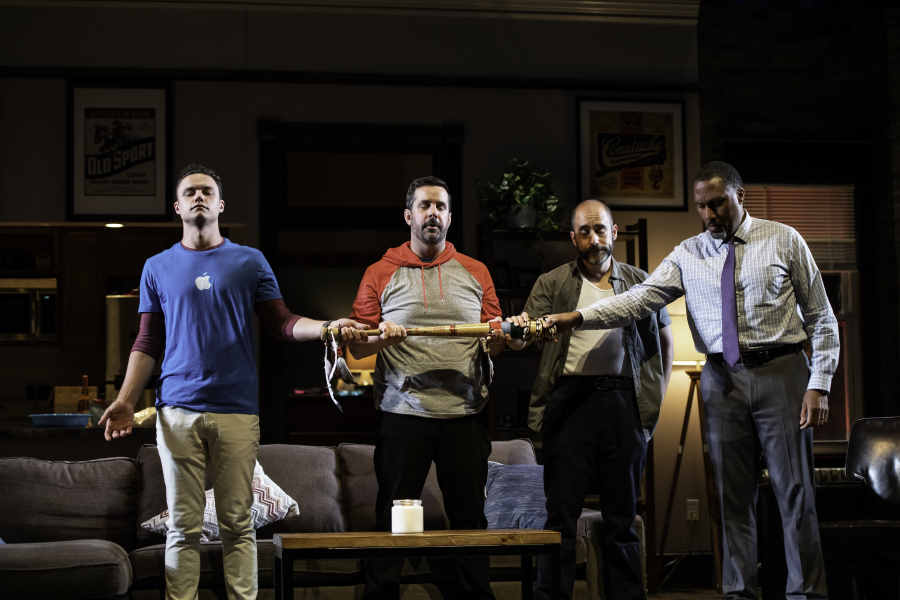
Clinton Brandhagen and Megan Anderson


When marriages go critical, as marriages will from time to time, the scenes and fights that embody the crisis will seldom be straightforward affairs.  As playwright Michael Weller intelligently conveys in Fifty Words, his recent off-Broadway success receiving its inaugural Baltimore production at Everyman Theatre, the emotions that will have led to the crisis were inevitably complicated things, and the crisis’ unfolding will be consistent with those emotions.  Except in the most empty marriages, no matter what the parties may have done to each other, there are still ties of love holding them together, however tenuously, in near-equipoise with the forces pushing them apart.

In living through these crises, then, both forces, the centripetal and the centrifugal, must have a part.  To the observer, it might seem laughably incoherent, but actually it is just the way things are at such moments.

There are two ways a dramatist can approach this reality.  He/she can make of the complexity a dramatic structure unto itself – one in which there is no truth but the struggle between the parties, and in which each mode the parties have of relating to each other, whether it be hugging on the one hand or screaming and throwing things on the other, is just another form of struggle for mastery, no more distinct, at bottom, than thrust is from parry.  That was Edward Albee’s approach in Who’s Afraid of Virginia Woolf?.

Fifty Words, though facially somewhat similar, actually takes the opposite tack, namely to treat seriously the contradictory emotions of the participants in the scene, to make the scene no more (or less) dreadful or dramatic than such a scene would be in real life, and to show the parties’ incoherence and ambivalence for what it is: the natural result of the messy lives lived to bring them to such a moment.  It is a canny approach, because few of us will attain much maturity without having lived through such scenes, and the shock of recognition will be considerable.

The subject being a fairly universal experience, the two characters in this two-character play are Everymen of a sort – at least of the sort who inhabit New York brownstones and send their children to private schools.  Adam (Clinton Brandhagen) is an architect, Jan (Megan Anderson) a former dancer turned freelance data-miner.  They are likeable, even endearing, without being terribly distinct.  Their nine-year-old son Greg, never seen onstage, may be slightly neurotic and/or afflicted with mild ADD.[1] What ails Adam and Jan’s marriage likewise is fairly typical: the inevitable fading of sexual novelty, the disappointments and pressures of their careers, the stresses of parenthood, and an affair Adam has been having which, not very coincidentally, chooses the night of their son’s first out-of-home sleepover to become known.

Even before Adam’s affair tumbles out of the closet, we see the ambivalent way they treat each other, in love but not always loving, finding it difficult to connect.  Once the mistress is acknowledged, however, the contradictions reach a fever pitch.  She throws things that break; she gets a splinter in her foot; he helps get the splinter out; they make love; she orders him to leave the home, etc.  He extols the way the mistress looks out for his feelings (as opposed to Jan, who he asserts does not), but then seems willing to promise whatever is necessary to revive the marriage – begging the question why, at least a little.

Whether the marriage actually will be saved is not revealed by the fadeout, though the play ends on a hopeful note.  But it is evident that if the two of them remain together, it will not be so much the saving of the extant marriage as effectively a third marriage for both of them, succeeding the hotly sexual early infatuation and the stage in which they built up a home and a family.

Marriages, Weller seems to be saying, are actually multiple successive events, for which a couple must consciously re-up every few years.  The title refers to the supposed number of words in Eskimo for snow (though I have also heard that this lexicographical multiplicity is an urban legend), and to a suggestion by one of the characters that there should be a similar number of terms for love (perhaps one for each iteration of a marriage).

I’ve not seen the various productions of Fifty Words (New York, Toronto, and Chicago, at least), but it seems that the play has undergone some changes since its 2008 premiere.  Everyman gives it a solid rendering with two veteran company members doing the honors in workmanlike fashion, fully and convincingly inhabiting two average professional-class New Yorkers living through a garden-variety crisis.  You believe in these characters from the outset, without finding either of them very remarkable, which I think is exactly right for this play.  Director Donald Hicken keeps the action humming and the emotions real.  And the set by Timothy Mackabee is a marvel, a straight shot through the fuselage of a brownstone with everything from a fridge to board games on display.

______________

[1]  One reader has suggested that I missed cues that the son’s condition is actually Asperger’s.  Could be; that is, it could be that we’re meant to think that.  What I read into it was that the parents were being bombarded with a lot of worrisome but ambiguous information of the sort that not always, but usually signifies merely that a child is having a rough patch, and, at worst, is probably at the benign end of the spectrum of horribles.

Copyright (c) Jack L. B. Gohn except for photograph

Theater Reviews Page | Previous Theater Review | Next Theater Review

Finding the Main Line

Theme Songs Page | Previous Theme Song | Next Theme Song

Finding the Main Line

Reasons for Waiting, by Ian Anderson, performed by Jethro Tull (1969), encountered 1970

Buy it here | See it here | Lyrics here

A hymn whose tune I like better than I do its lyrics contains the unfortunate line: “We are the young, our lives are a myst’ry.”  I think what the versifier had in mind (other than a rhyme for “history”) was the notion that young people cannot know what life will have in store for them.  But most of us use the word “mystery” to denote not an unknown outcome but rather a known set of facts that calls for an as-yet unknown explanation.

Yet when you’re young, there are times when the word “mystery” as most of us use it almost fits.  The facts of your life feel as if they should tell you what to do next, but you can’t make out what they’re saying.

The gorgeous Ian Anderson song Reasons for Waiting infallibly calls to my mind a moment of such frustration in my youth.  Or, more accurately, a time-out from that frustration.

When I hear it, I see myself sitting on a train.  Let me tell you about that moment and that trip.

Two Cars, Philly to Harrisburg

It was a beautiful morning, and I was traveling in a two-car train from Philadelphia to Harrisburg.  I had to take the trip on account of my car, that priceless gift from my dad within the previous year.  The only problem was that my dad and the car came from New York, and I didn’t.  I was a Michigander attending college in Pennsylvania.  So the time had come – and passed – for me to go to the Department of Motor Vehicles about re-registering it.  I’m pretty certain I’d neglected switching the car’s registration until the New York registration had lapsed, and in order to get the problem fixed I had to go at once to the only office that could deal with the problem immediately – in the state capital.  Hence Harrisburg, rather than Philly.  Hence train, rather than car.

Why had I neglected it?  OK, start with the fact that I had no more judgment and maturity than your average college student.  And like an average college student, I had to do a reasonable amount of coping on a daily basis.  I was holding down a very ambitious college curriculum and carrying on a serious love affair.  But I was also distracted by three big questions: what graduate school to apply to, what to do about the possibility I might be drafted, and whether to get married.  And obviously the resolution to any of these questions was tied up with the resolution of both of the others.  All of these things provoked anxiety; all of them called for grown-up powers of analysis I didn’t possess yet.  My mind was going in circles trying to figure them out.

Locum Refrigerii

And so in the midst of all this, one little bit of coping, the car registration, was allowed to slide too long.  Like most overdue tasks, this one came with a price: a day of downtime to get to Harrisburg and back.  If that day taught me a lesson, however, it had nothing to do with the consequences of negligence.  Rather it concerned the occasional moments of grace that drop into our lives, days where downtime unexpectedly becomes time out from one’s cares.

There was a phrase in my old Missal that captures what that day became: locum refrigerii, lucis, et pacis: a place of comfort, light and peace.[1]  For one gorgeous, sunny day I was forced to stare out the window of a cozy two-car train at some of the prettiest creation Pennsylvania has to offer, and I was so entranced by the unfolding scene that I largely forgot about being anxious.

The  train followed along the Main Line, that agglomeration of the old Main Line of Public Works of Pennsylvania comprised of canals, roads and rail, and more particularly of course the Pennsylvania Railroad’s Main Line to Pennsylvania.  Over the roughly 120 years that this rail line had been used, it had carried commuter trains for some of Philadelphia’s most elegant suburbs. I passed stations named Merion, Narberth, and Haverford, Villanova, Rosemont, Devon and Paoli.  And then, after a while, the suburbs gave way to Lancaster County’s broad fields.  As this was either advanced autumn or early spring, the vegetation was spare enough so I had an unobstructed view.  And finally, after a while, the line took me along the broad Susquehanna before depositing me near the Capitol.

I have a penchant and something of a gift for finding my way around strange cities, and I located where I was supposed to go quickly, and transacted my business without much trouble.  Shortly thereafter, I got on another train and reversed the route.

Faith in Impossible Schemes

And through much of that morning and afternoon, Reasons for Waiting was cycling through my head. It’s a peaceful song, despite the frequent appearance of strings.  The lyrics evoke a lover contemplating his lady, apparently asleep, perhaps in bed with him, perhaps only remembered (the lyrics grow abstract as they describe the time and the place of the lady).

What a sight for my eyes to see you in sleep.
Could’ve startled the sunrise hearing you weep.
You’re not seen, you’re not heard
but I stand by my word.
Came a thousand miles
just to catch you while you’re smiling.

And the lyrics conclude with a hope that the beloved has “faith in impossible schemes/ that are born in the sigh/ of the wind blowing by.”  Despite the mention of weeping and the “impossible” nature of the “schemes,” and despite some bruising jazzy interludes where Anderson’s gruff flute-work suggests conflict, the song remains serenely confident that the lady will say yes to whatever projects or commitments the singer may propose.

A Flourish of Flutes

The optimism of the song is assured by the strings and especially by a repeated flourish played by Anderson on the flute, backed by Marin Barre on another flute.  It appears at the beginning, middle, and end of the song.  If you remember one thing about Reasons for Waiting, it will be that incurably lovely flourish, perfect for accompanying the passing of suburbs and fields in all their own loveliness.

I was really sorry for the day to end, and to be consigned again to the less serene frame of mind in which I was spending that year.  Yet I couldn’t help thinking, then and now, that I was on a quest to discover the main line of my life, and that for a day at least, I had experienced what finding it might be like.


[1]   Memento etiam, Domine, famulorum, famularumque tuarum N. et N. qui nos praecesserunt cum signo fidei et dormiunt in somno pacis. Ipsis, Domine, et omnibus in Christo quiescentibus, locum refrigerii, lucis et pacis, ut indulgeas, deprecamur. Per eumdem Christum Dominum nostrum. Amen.

Translation: “Be mindful, O Lord, also of thy servants and handmaids, N. and N., who have gone before us with the sign of faith, and rest in the sleep of peace.  To these, O lord, and to all who sleep in Christ, we beseech Thee to grant, of Thy goodness, a place of comfort, light, and peace.  Through the same Christ our Lord.  Amen.”  Cited here as from My Sunday Missal, Rt. Rev. Msgr. Joseph F. Stedman, Confraternity of the Precious Blood, 1961, pg 54.  While the phrase is from the Roman rite of my childhood, and obviously refers to something more than a break from one’s cares, it is still the phrase that comes to my mind when I think of moments such as the one described in this piece.

Copyright (c) except for lyrics and artwork Jack L. B. Gohn

Theme Songs Page | Previous Theme Song | Next Theme Song


Net Worthlessness: Congressional Wealth and the Unstable Right

Previous I Read The News Today Entry | Next I Read The News Today Entry

Net Worthlessness: Congressional Wealth and the Unstable Right

A recent report by Peter Whoriskey in the Washington Post on the rising wealth of members of Congress contained a number of surprises, and some food for thought.

That Congressmen and -women are getting richer is not one of the surprises, to be sure.  Anyone paying attention knows that our legislators are the product of a system built around money.  So it comes as no shock that they might accumulate some of it.  For instance, former Speaker Nancy Pelosi reports personal wealth in excess of $101 million; Sen. John Kerry is worth double that and then some.  Nor is it much of a surprise that over time Congresspeople might get to keep more of the money that comes their way.  Between 1984 and 2009 the average net worth of members of the House of Representatives (excluding home equity) has more than doubled – at the same time that average household net worth of the public at large has receded slightly.

Bought Cheap

More surprising is that the average wealth of a member of Congress is still kind of paltry, less than three-quarters of a million dollars.  One would think the spoils would be greater than that. Many of us would be happy to have a net worth of three-quarters of a million dollars, but still, considering the vast sums of cash sloshing around in American politics, that average seems low.

In part it can be explained by the fact that there are a lot of members with negative net worths, likely the result of pledging assets to secure campaign debt.  Outliers can drag an average down.

Partisan Intensity

Still, it seems as if all that money is buying something – and that is the second big surprise.  Over the same period, between 1984 and 2009, the partisanship of Congress has increased in a curve whose profile to an uncanny degree mimics that of the net worth curve.  This partisanship is measured by an algorithm called NOMINATE (for “Nominal Three-Step Estimation,” if you must know), maintained by an academic named Keith Poole.  It seems to be the most respected metric of these things.

If you buy into the premise that throughout the length of American history there has been essentially one polarity in American politics – call it Left and Right – NOMINATE can tell you where any member of Congress has been on that polarity, based on almost every vote he/she has taken.  And what NOMINATE tells us is that seldom has Congress been more composed of consistently Left and Right members.  In other words, if they vote Left on one issue, they will, to a greater degree than is typical in American history, vote Left on other issues as well; and the converse holds true if they vote Right.  At the moment, these forces are roughly balanced, which partly accounts for all the gridlock you may have noticed.

Corporate Cash

Up until the 2010 Citizens United decision, individuals were the biggest contributors to Congressional campaigns, PACs a distant second, and corporations were excluded from directly donating, at least in the periods just before elections.  Held back by the floodgates of federal election law, until Citizens United opened them up, corporate money had to choose indirect routes to reach Congress at the most inconvenient times.  And perhaps it was that indirection that left Congress in a position where it still had an identifiable and viable Left, being as corporate money is usually associated with the Right, and individuals contribute across the spectrum.

Hold that thought about corporate money, though.

In the wake of Citizens United, we could expect that if corporate money is freer to influence elections, the balance in Congress would shift rightward – at least if the single-polarity analysis of NOMINATE is correct.  But there are reasons the single-polarity assumption might not hold true forever, because it’s doubtful that Right can continue to mean what Right means today.

Doomed Dixiecrats

A little history.  Consider the Dixiecrats during the New Deal.  They tended to vote for the Rooseveltian programs to regulate and stimulate the economy, which in the politics of that era was the Left position.  But they nearly completely checkmated any progress toward racial justice; maintenance of the privileged status of whites was the Right position.  Cumulatively, this combination of stances would have put Dixiecrats in the middle on that NOMINATE graph, as they voted Left on some issues and Right on others.

You could argue that the inconsistency of the Dixiecrats made them centrists, or you could say that there was in fact more than one polarity out there.  I leave that dispute to the experts.  But however you characterize it, that inconsistency left the Democrats standing for essentially contradictory things.  The party of that era was an inherently unstable compound.  And finally it disintegrated over the the apostasy of President Johnson, a Dixiecrat who broke with the South and made civil rights legislation finally happen.  This led to the Republicanization of the South.

Two generations later, however, the unstable coalition is on the Right.  It consists of two groups who, like the constituents of the New Deal Democrats, have little inherent reason to be in the same party.  Their interests, objectively viewed, are not aligned, though party voting discipline currently obscures this.

What Are These People Doing in the Same Picture?

For instance, corporate Republicans are injured by the social conservatives’ hostility to immigration.  It interferes with the education and retention of bright foreigners in the technical and financial sectors, and with access to cheap labor in agricultural and service sectors.  A recent dust-up over anti-immigrant laws in Alabama is a harbinger: corporate America took on the state and forced the socially conservative governor to blink.

Similarly, hostility toward government solvency and functioning looks like a corporate issue, but really is a social conservative issue, except where it comes to regulation.  Business needs a government able to maintain an educational and transportation infrastructure, and willing to bankroll scientific innovation.

Meanwhile social conservatives throng “the 99%.”  They may have bought into the notion that the gross disparities in distribution of wealth in our society is the correct working of a fair system.  But the very American families social conservatives so value are under financial siege because of that distribution.  Hostility to government regulation, to economic planning, and to efforts to combat climate change are not good for social conservatives.  It’s hard to foster family values in your home when your home is under water, figuratively or for that matter literally (as will happen to many coastal conservatives if climate change continues).

Money Will Have Friends Everywhere

It is a reasonable guess that corporate interests, being clearer sighted, will do most of the shifting if the Republican coalition comes undone.  It’s not as if much shifting would even be required.  Can anyone doubt that corporate money is in some fashion behind the wealth of the members of Congress named above – both of whom are Democrats?  Or that it has something to do with the prosperity of both parties’ lawmakers?  Of course, corporate interests would have to reckon with Democrats being the party of regulation and taxes.  But they may well decide to go with keeping their enemies close for a while.

If they do, we can expect to see those Congressional net worths continue to climb, even as current extreme party unity lessens.

Copyright (c) Jack L. B. Gohn

Previous I Read The News Today Entry | Next I Read The News Today Entry

The Age of Dross Begins

Theme Songs Page | Previous Theme Song | Next Theme Song

The Age of Dross Begins


The King Must Die! By Bernie Taupin and Elton John, performed by Elton John (1970), encountered 1970?

 Buy it here | See it here | Lyrics here

Icarus, by Ralph Towner, performed by the Paul Winter Consort (1970), encountered 1971

 Buy it here | See it here | Sheet music here

The albums piled up in the room of my housemate Otts, the music editor of the arts supplement to the campus paper.  In fragmentary but decided fashion they told the tale: The three-minute song was growing obsolete.  Singer-songwriters were now artistes, with all the pretensions that went with the role.  Monaural AM was no longer a reliable place to hear the good new stuff.

The musical Age of Gold in which I had grown up was just about over.  Whatever the merits of whatever was coming next, it wouldn’t be the gold I still wanted.  Wanted so badly, in fact, that I was willing to squint extra hard to see it in all the new vinyl that came sluicing into our house.

But of course when you squint, you are apt to see things that aren’t, strictly speaking, uh, there.

But Then Again No

One artist who turned up on Otts’ floor at this juncture in whom I ended up trying hard to see the gold was Elton John.  And he was some kind of gold isotope: he had the voice and the mannerisms to deliver a song, as well as the ear to compose catchy melodies.  The trouble was, his lyricist was Bernie Taupin.  That is sort of like Beethoven trying to be a great composer while limited to writing for the kazoo.

When John’s first significant album came out, I really tried to look past the lyrics.  That first number, Your Song, as a melody, was everything a pop love song could be.  But the awful lyrics were right there:

If I were a sculptor, but then again no.
Or a man who makes potions in the traveling show

No, what?  Or is the no there just to rhyme with show, which itself caps off a verse referencing a skill completely irrelevant to the singer’s aspiration to show the beloved how much he loves her?[1]  If not, name the task for which sculpture is inadequate but for which potion-making could be considered an improvement?  If Taupin were a lyricist, but then again no …

I could go on.  The thing was, I was still listening to the album a lot because of John’s magnetism as a singer.  But it kept not being utterly wonderful.

Ostlers, Mercenaries and Other Pointless Imagery

The song that ended the album was the one I played the most: The King Must Die!  To a student reading Chaucer and Shakespeare as I was at the moment, the medievalism and renaissancery of the lyrics, not to mention the dramatic central situation suggested by the title, was enough to hook me.  Yet I kept not loving it as much as I wanted.  Coming back to it 40 years later (and I include the beginning lyrics in an endnote so the reader can come back to it too),[2] it smacks me in the face: Who’s talking and who’s listening?  Stanzas 1-4 seem to be addressing a “king,” although there’s a strong hint he may simply be an everyman.  Stanza 5 sounds more like a response by the king.  But there are no clues in the music or the delivery.  In any case, the king seems to be in an ominous (in the literal sense of the word) situation.  But the omens seem wide of the mark: “Tell the ostler that his name was / The very first they chose.”  Well, so what?  Ostlers aren’t kings, and usually aren’t even addressed by kings.  What’s so bad for the king that someone chose the ostler?  Chosen for what?  And why are mercenaries singing in cloisters?  Shouldn’t it be monks?[3]  And if you must worry about mercenaries, isn’t it actually more reassuring to have them singing in cloisters than besieging your towns? In any case, the dramatic gravity of the music, underlined by Paul Buckmaster’s masterful arrangements, is utterly unearned.

At this point it would be a reasonable objection that Dylan did lots of the same thing.  I admit it, it’s true.  I’ve even written about that strain of Dylan right in this blog.  It’s just that Dylan was a genius who could get away with that sort of thing.[4]  And for that matter, Chaucerian touches worked well for Procol Harum in A Whiter Shade of Pale, even though there, as here, they didn’t add up to much.  But then that song was deliberately mysterious and impenetrable; that diverting talk about millers and hosts was meant to be disorienting, along with psychedelicisms about the ceiling flying away.

As I say, I listened to the album a lot, but interestingly, when I look back, I see I wrote at the time that: “with big new stars, like, say, Elton John, it’s impossible to determine, from their albums alone, whether they deserve their status or not, after you take into account the hype and arranging in back of them.”  So I guess I never quite convinced myself, even though now the source of my discomfort has little to do with the hype.

Reviewing Against the Grain

The comment I just quoted came from a review I wrote (at Otts’ suggestion) of the Paul Winter Consort’s Road album.[5]

Today, Paul Winter and his saxophone and his ensembles are shelved with the New Age musicians.  I tried to write about them as if they were to be considered along with rockers, likening the album to Sgt. Pepper.  My license to draw the comparison was the strong use of classical music elements in both, and the willingness of both albums to draw inspiration from anywhere.  But I tried to sell Paul Winter to my audience as if he and his consort were some kind of act to compare with, for instance, other acts mentioned in that issue of the paper: Laura Nyro, Richie Havens, the Youngbloods, Seatrain.

I wasn’t smart enough to take in that there were things out there besides classical, jazz, and rock – and that eclecticism didn’t necessarily lump an act with rockers.  This was my introduction to a new flavor, but my musical taxonomy wasn’t up to it.

I wasn’t wrong, though, about finding it fascinating, powerful music.  My Theme Song from the album – which has become Paul Winter’s own theme song, even though it was written by the guitarist in the Consort, Ralph Towner – was Icarus. The mythical Icarus, the fabricator of wings, flew too near the sun and paid with his life for his presumption.  Towner’s Icarus, so far as I can make out from the song, just discovers how intoxicating it is to fly.  The music is all about soaring, not falling.  There are wistful minor chords, to be sure, but just to make your breath catch as he upshifts into the major.

Not Bad for Not Rock

It is one of the great melodies, and covered in subsequent years by artists of all stripes.  I am particularly fond of a cover by Towner himself with a couple of other guitarists, of which there is a fine YouTube video here and of a cover by jazz pianist Stef Scaggiari.

A wonderful thing, but not rock gold, because not rock.  Maybe the reason, apart from my naivete, that I tried so hard to sell it to my contemporary 1971 readers as some kind of rock substitute was that if I had acknowledged it was something different and sui generis (at that time, anyhow), I’d have to acknowledge I was getting somewhat to one side of the popular tastes of the day, going back to being a bit of a wonk, as I’d started out.  Maybe, except for this: there is nothing wonkish about that sublime melody.  Listen to it, and you’ll want to soar too.


[1]   Well, if it is a her.  We all know now about John’s sexual orientation, but at that time he was in the closet to his American fans.  (He apparently came out as bisexual in 1976, but it was only much later that he self-identified as gay.)

[2]   No man’s a jester playing Shakespeare

Round your throne room floor
While the juggler’s act is danced upon
The crown that you once wore
 
And sooner or later
Everybody’s kingdom must end
And I’m so afraid your courtiers
Cannot be called best friends
 
Caesar’s had your troubles
Widows had to cry
While mercenaries in cloisters sing
And the king must die
 
Some men are better staying sailors
Take my word and go
But tell the ostler that his name was
The very first they chose
 
And if my hands are stained forever
And the altar should refuse me
Would you let me in, would you let me in, would you let me in
Should I cry sanctuary

[3]  And I’ll confess I’m charmed by the “Roman cavalry choirs were singing” in Coldplay’s Viva la Vida (2008) — but Coldplay also know what they’re doing with the lyrics.  In their hands this is clearly an extravagant metaphor for the exalted feelings one experiences while successful in love.

[4]   Similarly, compare two couplets, one from Taupin, one from Dylan, that describe things that cannot possibly happen to a piece of headwear:

Taupin: While the juggler’s act is danced upon
The crown that you once wore
 
Dylan: You know it balances on your head
Just like a mattress balances on a bottle of wine

(From Leopard-Skin Pill-Box Hat (1966).)  Dylan knows he’s spewing nonsense, with the aim of making you laugh.  Dylan knows mattresses don’t  balance on bottles of wine, leading to a busted simile; that’s what makes it funny. Taupin is trying to be portentous but fails to notice that he’s describing the literally impossible.  That what makes it unimpressive.  Advantage Dylan.

[5]   34th Street, February 25, 1971 at 8.

Copyright (c) Jack L. B. Gohn, except for album art

Theme Songs Page | Previous Theme Song | Next Theme Song

Unnecessary Roughness

 The Big Picture Home Page | Previous Big Picture Column | Next Big Picture Column

Unnecessary Roughness

Published in the Maryland Daily Record December 5, 2011

U.S. District Judge Jed Rakoff would probably be happier with some of the state agencies I regularly deal with than he was last week with the Securities and Exchange Commission.  He refused to endorse a settlement of an enforcement action by the SEC, in part because the defendant, Citigroup Global Markets Inc., wasn’t required to admit the allegations against it.  In my own practice, I tend to encounter the opposite problem.  My state regulator adversaries seldom agree to a disposition of an enforcement action without an admission of guilt by my client.  Rakoff thus attacked a kind of administrative prosecutorial discretion I’d like to see more of.

Why The Judge Was Mad

The allegations against Citigroup are pretty bad.  It’s said that when in 2007 Citigroup held a load of mortgage-backed securities it well knew to be dubious, Citigroup arranged for some allegedly independent but secretly paid-off expert to tout the vitality of these stinkeroos, tricking investors into taking them off Citigroup’s hands.  Citigroup then sold short against the very securities it was about to dump.  After the securities did what Citigroup knew they would do, i.e. tanked, the final score (allegedly) was Citigroup: $160 million profits, Investors: $700 million losses.

Rakoff was annoyed with the settlement because Citigroup was charged only with negligence, not fraud (only its employee was charged with fraud).  Investors can’t sue for mere negligence.  Moreover, the settlement would have forced the disgorgement of Citigroup’s profits plus interest, but would not have necessarily landed a single penny back in the pockets of the investors.  Third, and most upsetting to the judge, the settlement would have had zero collateral estoppel effect.  The settlement would have given investors suing Citigroup no established factual basis for their own fraud actions. They would have had to have proved their cases from scratch.

Of course, Citigroup also promised never to do in future what it neither admitted nor denied having done in the past, and agreed to be enjoined.  That agreed injunction was Judge Rakoff’s way in; as every litigator knows, an injunction can only be granted after the court takes the public interest into account.  And Rakoff found that the public interest would not be served if Citigroup admitted nothing, particularly if the investors were not made whole.

Why The Judge Was Wrong

I wish Rakoff had stayed with his first two gripes, which I think were legitimate.  The timidity of SEC in undercharging Citigroup and in not trying to build restitution to defrauded investors into the settlement seems unfortunate.  But saying that there was a public interest in admissions went too far.

For one thing, the whole point of a settlement is to leave something on the table for each side.  For a person or company at the receiving end of an administrative enforcement action, that something can take the form of facts not admitted.  It is a natural quid pro quo.  Usually, the agency will get the sanction it seeks.  And usually, not admitting facts protects against grave practical consequences.

Nothing Collateral About Collateral Damage

Typically, the consequences when facts are admitted are collateral.  The statutory sanction the agency seeks and will typically receive in a settlement (delicensure of a professional, fines and disgorgement for a corporation, and the like) will be direct.  But if facts are admitted, the damage to the regulatee will go on in ways not contemplated by the agency’s own organic statute.

For example, even if the professional is re-licensed someday, he or she may be unable to obtain, directly or indirectly, federal reimbursement – which in many practices, including medicine, is a death sentence.  A government contractor may be debarred, another kind of death sentence.  Admitted facts may lay a company like Citigroup open to huge claims through collateral estoppel.  Risks may become uninsurable.  Financing may become unavailable.  Individuals may be deported.  And above and beyond these consequences, there is the damage to reputation and to pride.

Typically, as noted, the agency’s founding statute charters it to pursue none of these consequences.  Yet administrative prosecutors and/or regulators who insist on found facts are knowingly inflicting them.

Blood Lust

This unnecessary roughness, I maintain, is not in the public interest.  That interest, established by thousands of disciplinary statutes, should begin and end with the linkage articulated in those statutes between specified misbehavior and specified sanctions.  Those sanctions are the only consequences in which the law establishes a public interest.  With those sanctions achieved, the establishment of the facts of the misbehavior – at least by the prosecutor or agency in question – is not important.

Why then is it pursued?  Often, I believe, from the conscious desire to inflict those collateral consequences, a blood-lust to stigmatize.  I’ve seen prosecutors self-righteously bent on taking errant professionals “off the road” to greater extents than the laws they are supposed to enforce warrant.  And I’ve definitely seen regulators afraid of being tagged as the ones on whose watch some malefactor got off insufficiently stigmatized.

Am I saying then that the public has no interest in finding out what really happened?  For instance, is there no public interest in getting to the bottom of Citigroup’s alleged mammoth pump-and-dump?  No, I think the public does have an interest, and a Congressional hearing or a journalistic investigation would be an appropriate way of vindicating it – not to mention what comes out of private lawsuits.  But prosecutions, administrative or otherwise, serve a different aspect of the public interest, namely in protecting the public by sanctioning certain kinds of misbehavior.  The fact-finding function is purely incidental to that service.

No Incentive To Settle

Practically speaking, if the incidental fact-finding is not allowed to be dispensed with in settlement, it leaves most regulatees very little reason to settle.  If the administrative prosecutor or the regulatory board insists on the statutory sanction plus admissions of all facts, the settlement is nothing more than a surrender.  And why should the regulatee who can afford a legal defense just surrender – at least when there remains the faintest chance of a successful defense?  The inefficiency of the resulting trial in terms of the time and cost to both sides (one financed by taxpayers, let’s not forget) is considerable.

In fact, even the word surrender may not always capture the essence of the prosecutorial overkill.  Many professionals, once charged with misconduct, cannot merely unconditionally surrender their licenses; boards will not even accept the surrender without admissions being made.  It becomes a strange conditional surrender, in which, contrary to the usages in warfare, the victor sets the conditions.  Unless the professional gives the demanded admissions, the professional must withstand an administrative trial he or she does not even wish to contest.  This is show-trial time; this is madness.

Enough With The Mea Culpas

One can applaud Judge Rakoff for trying to make SEC get a backbone.  If the SEC had insisted on restitution, one can guess Rakoff would not have harped on admissions.  But the SEC didn’t do that, drawing the judge off-base.  It would be unfortunate if this high profile case further increased the respectability of the practice of shaking down regulatees for admissions when the regulators are already getting, practically speaking, everything they wanted.

They should be encouraged to take yes for an answer, without a particularized mea culpa attached.

Copyright (c) Jack L. B. Gohn

 The Big Picture Home Page | Previous Big Picture Column | Next Big Picture Column